Terri’s seizure and trip to the hospital
A Dog's Way HomeTerri’s seizure and trip to the hospital turn an ordinary afternoon into a crisis that Bella can sense before she can understand it. Bella notices a change in Terri’s body and behavior, tries to stay close, and then barks until Lucas recognizes that Terri is in danger. The episode reveals that Terri’s seizures have returned despite medication, while making Bella’s unschooled attentiveness central to how the family experiences the emergency.
Background and Warning Signs
The day begins with a familiar routine: Terri has just brought Bella inside and is unclipping her leash. But Bella detects that something is wrong before Terri has identified it clearly herself. Terri’s sweat smells sharply different, and Bella responds by sniffing her anxiously. Terri praises her, yet her attention is fixed elsewhere; she says that she feels strange.
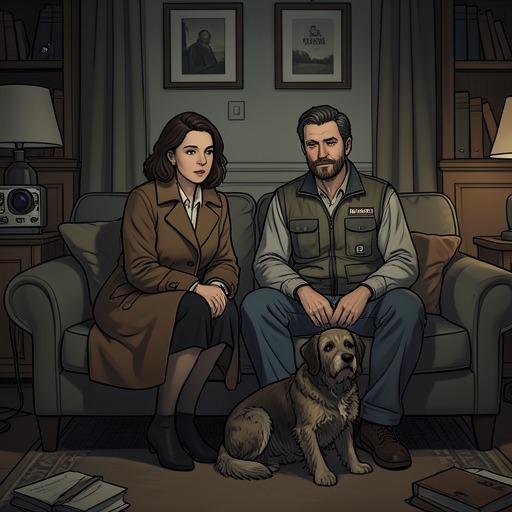
The difference becomes more apparent when Terri sits down to watch television, an activity that normally means shared time on the couch while Lucas and Terri pet Bella. This time, Terri’s hand feels shaky and tense. Bella repeatedly gets down, curls at Terri’s feet, returns to her, pants, drinks water, and noses her leg. Her movements form a pattern of testing whether Terri is all right: she leaves briefly, comes back, and finds the unease still worsening. Bella cannot name the danger, but her close attention to smell, touch, and behavior registers its arrival before the people around her respond to it.
Terri first wonders whether Bella needs to go outside, then urges her to go downstairs for a treat. The snacks attract Bella, but she runs down because she wants Lucas; in her understanding, he is the person who makes things right when something is wrong. As she eats, a loud crash comes from above. The apparent reassurance of a routine treat lasts only until that sound breaks it.
The Seizure and Bella’s Alarm
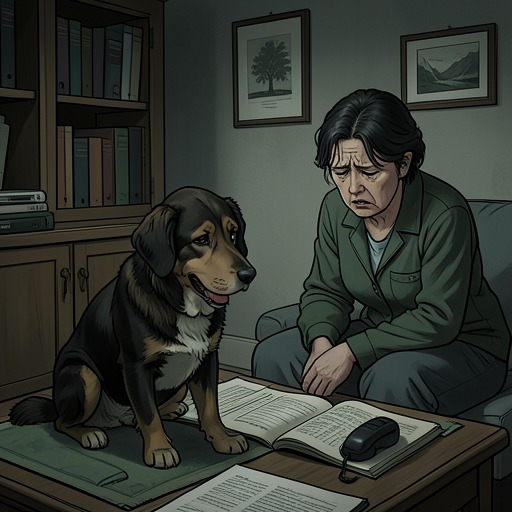
Bella races upstairs and finds Terri curled on the floor, making small sounds, with her hands raised near her face and shaking. Bella tries to comfort her by putting her head on Terri’s shoulder, but the shoulder remains rigid. She barks repeatedly. Terri’s shaking lessens after a moment, though she continues to move her lips and groan; Bella’s attempt to help brings her close to Terri, but cannot tell her what has happened or make Terri respond normally.
Bella senses Lucas approaching and waits for him. When he arrives, he first objects to her barking and asks whether Terri is taking a nap. Bella runs between him and Terri, barking over and over, including after Lucas tells her to be quiet. Only when he comes around the corner, sees Terri, and feels her neck does he understand the seriousness of the scene. Bella nuzzles Terri’s cheek as Lucas reaches for his phone and calls for help, shouting for someone to hurry.
The sequence turns on a mismatch between what Bella perceives and what Lucas initially assumes. Her alarm is unmistakable to her, but the familiar household rules against barking lead Lucas at first to treat the noise as misbehavior. Bella keeps returning to Terri rather than settling down, and that persistence brings Lucas to the crisis he has not yet seen. Her response is instinctive rather than trained: she detects the change, stays beside Terri, and uses the one signal she has to make the emergency known.
Medical Response and Immediate Aftermath
People arrive at the home, but Lucas has locked Bella in his room, leaving her able to smell and hear the commotion without seeing what is happening. At first there is considerable noise; then the front door closes and the house becomes quiet. Bella realizes that Lucas has gone with the others and that Terri does not wake when he touches her. Confused and frightened, she cries, whimpers, scratches the bedroom door, and barks, trying to make someone understand that she has been left alone and needs help.
The following morning, Lucas takes Bella for a walk as the sky brightens. He explains that Terri has had another grand mal seizure, although she had not experienced one of that severity for a long time. The medication had seemed to have the seizures under control, but the doctors are unsure what is wrong with her. His account supplies what Bella could not know during the emergency: the collapse is not an isolated puzzle without a history, but a recurrence in an ongoing medical condition, and its cause remains uncertain.
Terri does not come home that day or the next. When Lucas goes to work, Bella is left in her crate, barking in frustration and fear. Her distress is shaped by two absences at once: Terri is still away, and Lucas has to leave her behind. Bella tries to be good, sit, and offer comfort, but those familiar acts cannot bring either person back or explain when Terri will return. The aftermath therefore extends the crisis beyond the seizure itself, into Bella’s experience of separation and the household’s disrupted routine.
Recurring Care and Narrative Significance
The episode establishes a pattern that Bella’s later experiences broaden: care begins with noticing vulnerability and answering it through proximity and action. When Bella later encounters Big Kitten, she recognizes the young animal’s fear and feels drawn to protect her, recalling how Mother Cat protected Bella. She stays still while the kitten examines her, then lets the kitten curl against her side. Bella understands this as comfort offered to a helpless young animal, much as she had tried to comfort Terri.
That care is practical as well as emotional. At Sylvia’s swimming pool, Bella dives in to rescue Chloe’s kittens from the water, lifting them to the edge so their mother can lick them and carry them away. Later, beside Axel, Bella remembers sharing the close, cold nights with him and the food he shared with her. These later episodes do not make Bella’s response to Terri a trained medical intervention; they show instead how consistently she attends to frightened or dependent beings. In the seizure scene, that instinct is first expressed within her home, where her barking becomes an urgent, imperfect attempt to summon the person who can act.